Matun Village at a glance — figures sourced from public industry reporting and our production records.
The first message from a new buyer usually holds the same three questions. Who actually makes these drums? Is the quality the same from one order to the next? Can you put our logo on the drum? These three questions come up before anything else gets settled, because the answers decide whether the rest of the conversation is worth having. All three lead back to one place: Matun Village, Gousi Town, Yanshi District, Luoyang, Henan.
Nearly 80% of China’s large drums are made by hand in this village. Locals call it China’s number one drum-making village. Three thousand villagers run more than 300 workshops, close to two-thirds of the village makes a living from drums, and the trade supports nearly 2,000 more workers in the surrounding towns.
The craft is old. During the late Eastern Han dynasty, drum makers in Luoyang fled the chaos of war and settled around Gousi. Their tools and techniques passed from hand to hand for close to two thousand years. In 2020, the Ma family drum-making technique entered the Luoyang intangible cultural heritage list. QiaTuo’s drums come out of these workshops, which means your order gets made by people who have done this their whole lives, not by a line that added drums to its catalog last year.
Six Steps From Wood to a Finished Drum
Every drum passes through the same six stages: hide selection, shell building, stretching, row-nail fastening, hand tuning, and painting. The order never changes, and neither does the standard. Two stages decide whether a drum is worth the money, and both are the first things you should check at inspection.
STEP 3–4Stretching and row nails
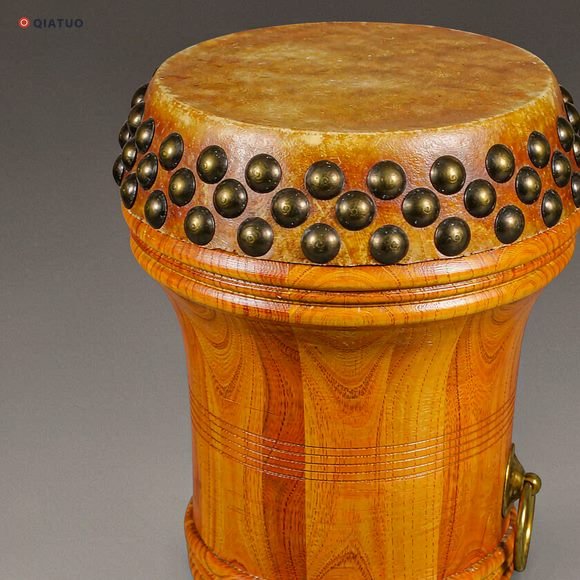
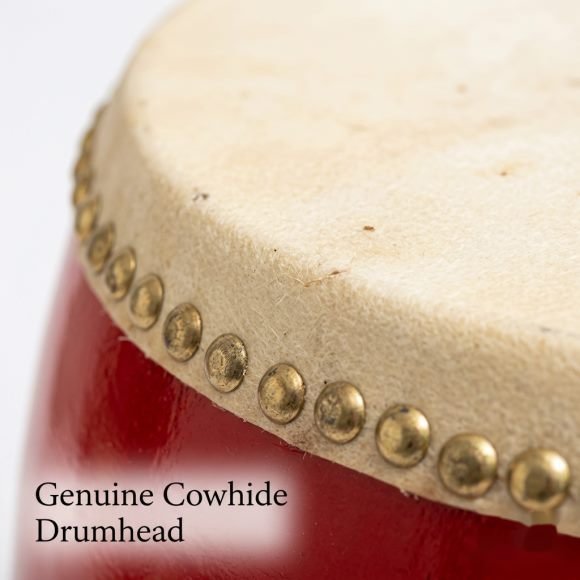
The head starts as one piece of natural hide. It gets depilated only, never chemically bleached. That single detail decides how long the head stays tight years from now. Once the hide is stretched by hand, row nails lock it to the shell. Lion dance drums and large hall drums use this same fastening: gold round-head nails pressed in even rows, four rows being the common setup.
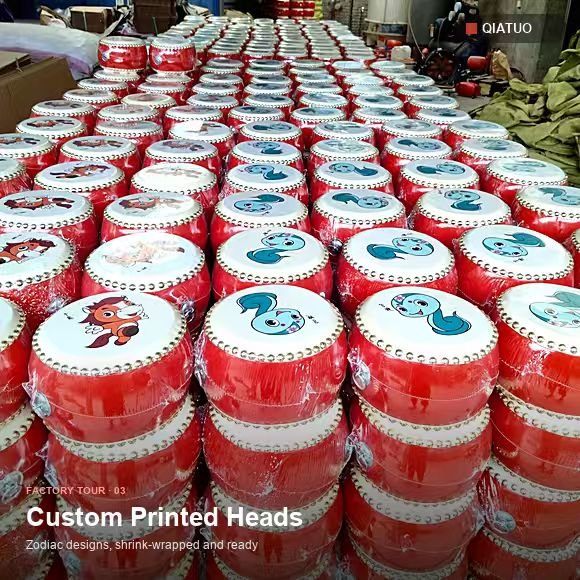
The nail line tells you a lot. Look at the spacing, check whether any nail head sits crooked, and turn the drum around before you make up your mind. Run a thumb along the edge where hide meets shell; a clean line means the hide was stretched evenly, while a wavy edge means someone rushed the step. A workshop that cuts corners usually shows it here first.
STEP 5Hand tuning
You cannot photograph this step. A master strikes each face with a stick, listens, works on the tension, then strikes it again. He moves around the drum, comparing faces to each other, because a drum with one tight face and one loose face will never sit right in a parade. One large drum goes through several rounds before it leaves the bench. A machine can hit the right pitch, but the carry you hear twenty meters down a parade route comes from these hands.
STEP 2The shell and the hide
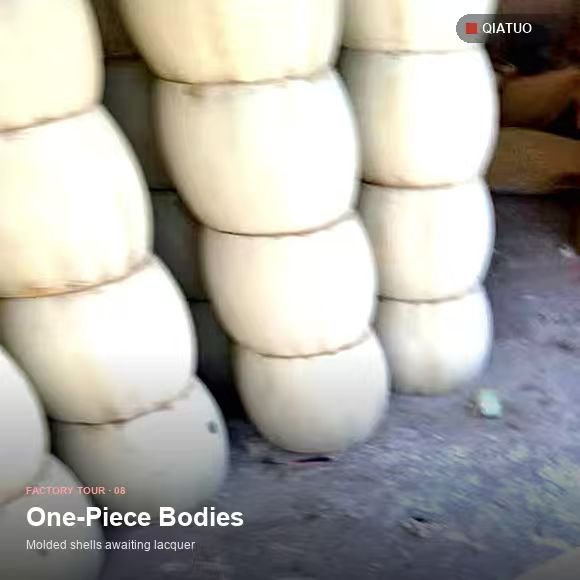
Wood is the other decision point. In the tanggu line, shells up to 16 inches use paulownia, while 18 inches and above switch to poplar. One product line, two woods, two different voices. Hide lines split the same way. The ethnic drum line pairs yellow cowhide with toon wood shells. Tanggu, waist, flower pot, sanjuban, and team building drums run on buffalo hide, first layer as the premium option and second layer as standard. We will go deeper on both lines in separate guides.
Matching Sizes to the Job
Matun workshops label sizes in both Chinese cun and meters, so conversion on export orders stays straightforward. The table below is the short version we send buyers who are comparing lines for the first time.
| Drum family | Tiers | Range | Best for |
|---|---|---|---|
| War drums | 10 | 10 in – 2.5 m | Parades, ceremonies, ensembles |
| Tanggu drums | 15 | 7 in – 1.5 m+ | Opera, orchestras, temples |
| Kids drums | 9 | by age group | Early learning, classrooms |
| Waist drums | 4 | by age group | Yangge teams, school troupes |
Flower pot, storytelling, fan, sanjuban and team building drums each carry their own full tier set — ask for the chart.
If you are unsure where to start, work backwards from the room. Twelve to sixteen inches for indoor practice. Twenty-one to twenty-four inches for a performing troupe. One meter and above for parades, temples, and large ceremonies. Tell us the venue and the audience size, and the right tier usually falls out of the conversation on its own.
What to Check Before You Order
Start with the venue, not the catalog size
A parade drum has to throw sound over distance. A stage drum has to keep its layers clean up close. Those are two different drums, and the biggest one in the photo is not automatically the right one.
Do not compare hide prices across lines
Yellow cowhide and buffalo hide sit in different positions, and the gap between first and second layer is real. A troupe playing weekend events does fine on second-layer standard. A team that marches every week should go straight to first layer. Buying the cheaper hide for daily outdoor work just brings the replacement date closer.
Inspect the shell first at the factory
Look at the glue seams between boards, the putty work, and the evenness of the paint. These are the three places where cutting corners is easiest and hardest to hide.
Judge customization by finished examples
Sizes, artwork, troupe logos, and gold lettering are all in range, and the paint-your-own raw shell drums exist for buyers who want to finish the art themselves. OEM and ODM orders stay in the village from sample to mass production. We confirm minimum order quantities, sample fees, and every other parameter with you line by line before quoting. Every drum carries a one-year warranty.
The Three Questions Buyers Ask Most
Why do overseas buyers all point to Matun Village?
Because nearly 80% of the country’s large drum capacity sits in one place. The work splits fine enough that every step has people doing only that step, day after day. One village covers everything from a 7-inch drum to a 2.5-meter ceremonial drum, so you are not gluing together shells and heads from three different factories and hoping they match. When one workshop cannot finish an order on time, the next bench over can pick it up.
Yellow cowhide or buffalo hide?
Pick the drum line first, then the hide. The ethnic drum line runs yellow cowhide. Tanggu, waist, flower pot, sanjuban, and team building drums run buffalo hide, with first layer as premium and second layer as standard. Within one line the two layers sound different and wear differently. Send us where and how often you play, and we will tell you which one fits.
Is the minimum order high for custom work?
Sizes, artwork, and logos are all open to customization, and the sample fee depends on the process rather than a flat rule. Rather than reading a range off a page, send the size, quantity, and use case. We confirm the plan and every parameter in writing before production starts, so what you approve is what gets built.
More questions? The answers usually take one message — the contact is right below.
See the Drums First
Two lines show the range best. The QiaTuo tanggu drum line runs from 7 inches past 1.5 meters and covers most ceremony and ensemble work. The lion dance and dragon drum line is what performing troupes use as daily equipment. For custom work, read our OEM and ODM service, or message Jack Tang on WhatsApp at +86 186 3881 7907. This site explains what we do. Quotes and factory visits happen offline.