A finished Chinese drum looks simple. A wooden barrel, a skin face, a ring of nails, a coat of paint. Behind that simple shape are six separate steps, and every one of them changes how the drum sounds, how long it lasts, and how it looks standing on a stage.
We build drums in Matun Village, the workshop cluster where most of China’s drums are made. This guide walks the real sequence, from a raw hide to a head you can tune and play, and points out what a buyer should look at at each station — whether you are ordering one lion dance drum or forty for a school program.
Quick Look: The Six Steps
| Step | What happens | What buyers should check |
|---|---|---|
| 1. Select the hide | Cowhide or buffalo hide is sorted and graded | Even thickness, clean surface, no weak patches |
| 2. Build the shell | Wooden boards are shaped into a barrel | Straight seam, smooth inside wall, right wood for the size |
| 3. Mount the hide | The damp hide is stretched over the shell | Tension sits level all the way around |
| 4. Nail the rows | Gold round-head nails lock the skin in place | Straight nail lines, even spacing, four secure rows |
| 5. Hand tune | A craftsman tunes the head by ear | Clear tone at the center and near the rim |
| 6. Lacquer and finish | The body is painted, sealed, and inspected | Even coat, clean edges, no drips |
Step by Step: From Raw Hide to Tuned Head
STEP 1Selecting the hide
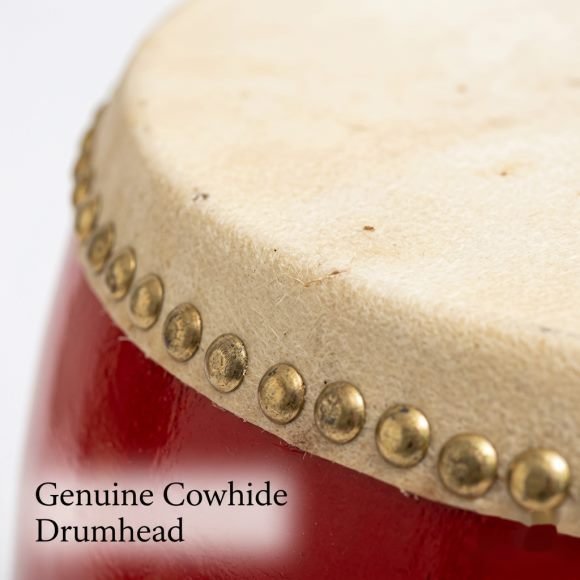
Everything starts with the skin. Two hides do the work here: cowhide and buffalo hide. Cowhide is tighter and carries a bright, carrying tone — it suits lion dance drums and other single-face instruments where the sound has to cut through a parade. Buffalo hide is thicker and heavier. On our tanggu, waist drum, flower pot and sanjuban lines, the first and second layers of buffalo hide are used, each chosen for a different range of sizes.
A tanner or craftsman grades the hide before anything is cut. Thickness has to be even across the piece, because a thin spot becomes a dead spot on the drumhead. Scars, brand marks, and stretch marks are worked around or trimmed out. Buyers can ask which hide a drum uses and where on the body it sits — a supplier who answers that without hesitation knows its materials.
STEP 2Building the shell
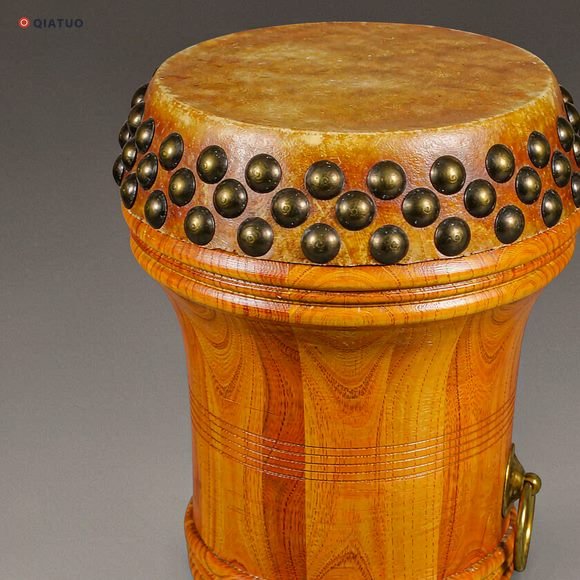
The shell is the drum’s body, and the wood decides its weight and resonance. For tanggu drums up to 16 inches, paulownia is the standard wood: light, easy to carry, quick to respond. From 18 inches up, poplar takes over because the larger shell needs the extra strength. Lines built for cowhide heads commonly use toon wood, which is dense and takes paint well.
Boards are cut, shaped into a barrel, and joined. The inside wall is sanded smooth — rough spots inside a shell catch the air and muddy the tone. The seam runs straight; a shell that has shifted out of round will never hold even tension in the later steps.
STEP 3Mounting the hide
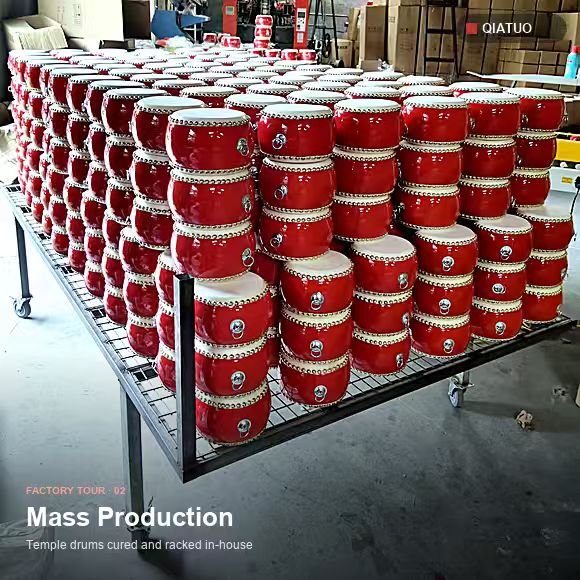
The hide goes on damp. Water makes the skin pliable, so a worker can pull it over the shell and work the tension out evenly, edge by edge. As the hide dries, it shrinks and tightens against the wood — that shrinking is what gives a hand-made drum its voice.
This step is where cheap drums and careful drums separate. If the hide is pulled unevenly, one side of the head will be tighter than the other and the drum will sound two-toned no matter what you do later. On our floor, the worker checks the surface with a flat hand before the hide sets.
STEP 4Nailing the rows
Gold round-head nails lock the stretched skin onto the shell. Our drums use four rows of them — the pattern you will see on professional lion dance drums. The nails are not decoration. Each row adds a stage of hold, so the head stays tight through heat, humidity, and years of hard playing. Spacing is set by hand: a nail driven too close to its neighbor tears the skin; too far apart and the edge lifts.
The nail line is also the first thing an audience sees up close. Straight rows read as careful work, and buyers inspecting photos should look at the nail lines first.
STEP 5Hand tuning
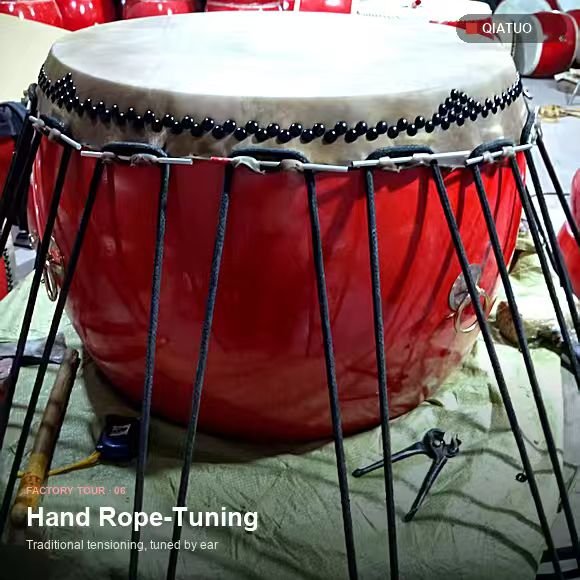
A drum is not finished when the skin dries. A craftsman tunes it by ear at the bench, working rope tension around the head and listening after each pass. He is listening for two things: a clear tone when struck at the center, and a clean response near the rim. Drums that fail the check go back a step — more tension, or a new look at the mounting.
Tuning by ear is slow. It is also the reason two drums of the same size can sound different from each other, and why buyers who order samples usually keep them.
STEP 6Lacquer and finish
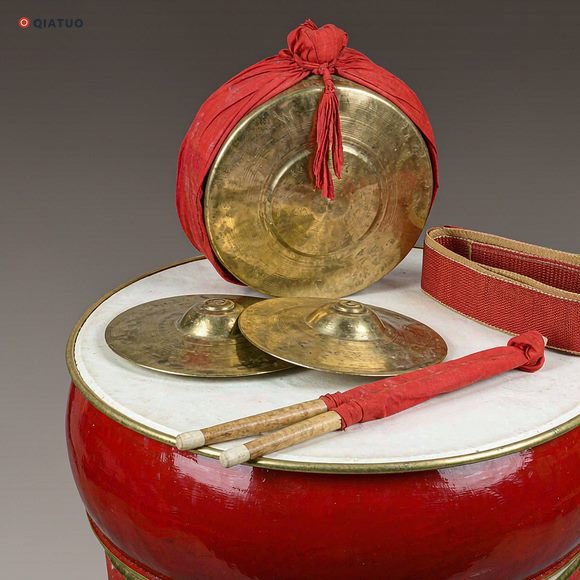
Last comes the finish. The body is painted and sealed, which protects the wood from humidity and gives the drum its stage color — red for temples and celebrations, black for stage work, custom colors when a buyer asks. Edges are wiped clean, hardware is checked, and the drum gets one final look-over before it is packed.
What to Check Before You Order
- Which hide the head uses, and whether it is first or second layer buffalo
- Which wood the shell uses at your size — paulownia under 16 inches, poplar above 18, toon on cowhide lines
- The nail rows: four straight rows of gold round-head nails
- A tuning check on video before the drums leave the factory
- The finish color, and whether custom colors are available for your order
If you are building a full order — a school set, a troupe’s replacement drums, a private label line — our OEM and ODM program covers shell size, hide selection, finish color, logo work, and packing. Our team can walk you through the same six steps on your own specs.
Frequently Asked Questions
How are Chinese drum shells made?
Shells are built from wooden boards shaped into a barrel and sanded smooth inside. The wood changes with the drum’s size and line: paulownia for tanggu up to 16 inches, poplar from 18 inches up, and toon on lines made for cowhide heads.
Are Chinese drumheads real animal hide?
Yes. Traditional Chinese drums use cowhide or buffalo hide. Buffalo hide is thicker, and on tanggu, waist, flower pot, and sanjuban lines, the first and second layers are used to match different drum sizes.
How is a Chinese drum tuned?
By hand, at the bench. A craftsman works rope tension around the head and listens after each pass — checking a clear tone at the center and a clean response near the rim. The final tune happens after the hide has dried and the nail rows are set.
Ordering Drums From the Source
Most buyers come to us with a size in mind and questions about the rest. Tell us the drum type, the size, and how the drums will be used, and we will come back with hide and shell options, finish choices, and a quote — or start with a sample drum and check the six steps yourself at your own bench.